

Dev Log III
November 15, 2025
If you chose to read all three of our first Dev Logs, it’s worth getting a bit more personal now. Surely if you’ve read this far, you must love the game. (If you skipped ahead for some odd reason, well, that’s fine too.) On the chance you hate it, or have any critiques whatsoever, we want to know why, as it’s very valuable to a developer to be given input of any kind, whether positive, neutral, or negative.
We would like to speak frankly about the social status we know a game like Chaoscraft to hold. In essence, what we have here is nothing less than an industry anomaly. We’ve published this peculiar site out of the blue. We won’t launch on Steam, we aren’t active on some of the social media platforms, and our first YouTube promo is a short low-budget video. We also don’t have a subreddit yet, a Discord is to come in the future, and it has no wiki as of this date. All of these we hope to update soon. We’ve been very busy with initial site launch and the game’s future development. As the game has this aura online, I tell my colleagues Chaoscraft holds the status of a ghost game.
This is both a game that has no firm basis anywhere on the internet, and bears such a ghostly signature it makes one question its reality and feasibility on some level, validly so. I myself have repeatedly questioned the limitations of the game. It wasn’t long before I realized, if you design the substrate system in a cunning enough way, it can foster any imaginable reality. This is a question we go into great depth on in the Experimentalism page, where we’ve laid out a formal template of the game’s architecture and dynamics.
It is to be expected in a new title that strives for this level of experimentation, laying out the vision is going to take a very detailed level of scrutiny, questioning both one’s own game and others’ views on it. I emphasize this in the sincerest terms: If Chaoscraft’s potential is doubted on any level, this doubt must be articulated, so we can assess it and potentially find it to have merit. Likewise, one may also find it holds even more potentials than initially imagined. This is what I’ve personally found. You look at something and remark, “Is there anything else?” And the answer always seems to be, invariably: “Yes.”

Saga and Showdown
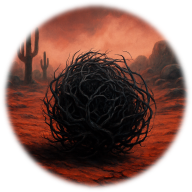
It was around the time of the Wild West society began to see a thematic fixation on the epic finale we call a showdown. There were many showdowns in both history and fantasy that preceded this era. Something about the Wild West brought with it a fascination with them. These are heavy, emotional moments when two or more enemies face each other in mortal combat.
In the old days, this was usually a quick shootout, bang bang, bullets fly and graves are dug. Over time, the tradition evolved, taking new shape in the genre of anime, which to this day echoes the Wild West. Here, powerful and otherworldly personas do battle, often deciding the fate of the world. As a curious side note, we rarely see quality anime in which characters do not decide the fate of any world or major place at all. One of the only ones like this I can think of off-hand is a now iconic story about two Samurai and a girl who travel across Japan in search of the girl’s father. I won’t say what happens in the end, for those who haven’t seen it. There is something charming and even hypnotic about a story like this – the characters are more or less nobodies, the fate of the world isn’t in their hands, and yet their tales, their lives are invested with such emotional gravity and passion, the viewer is just as captivated. Further, when they are not presented as all-powerful heroes who hold the whole world in their palms like an apple, but are instead closer to the average person, the story somehow feels realer.
This is a theme I’ve personally observed in MMOs. Despite the overarching story usually being of world-shattering proportions, many of the live encounters between actual players resemble the story of the Samurai. Hated rivals and their crews tangle out in the open world or in the walls of ranked Arena. Friends and strangers travel on their own personal quests, facing random encounters along the way and making new friends or enemies.
Occasionally, especially late at night, one will experience an exchange – whether of words or swords – that burns into one’s memory forever. Some of these are such epic showdowns, they feel like the whole world is at stake even if it’s only the lives of two warring heroes or villains. This is showdown. It isn’t only about the final match between the Rank 1s at the season’s climax, or the bleeding fates of a legendary duel.
Chaoscraft creates endless opportunities for sagas and showdowns. All one has to do is step out into the world, somewhere, someday, and you’ll find a story there waiting to be written. If there’s one thing game creators have learned over the decades, it’s that players write the story themselves.
Raw Villainy

Now, it is here I must warn you. If you believe you know all Chaoscraft is, think again. Unless you’ve seen us use the term raw villainy and know exactly what we mean. I wonder… Do you?
Villains were never scripted puppets dancing on strings for the public’s amusement like loot pinatas to be bashed until they drop all their candy. In the early days of MMOs, this had its own charm like other things. It still does in a way. Yet the word villain indisputably cannot be limited merely to predesigned, prestructured foes who can more or less always be metagamed into Oblivion. Since the very youngest eras of literature and film, villains were always their own individuals, free-ranging minds who can think like you and me. Real life villains are no different. They think. They feel. They move in accordance to their own will.
Raid bosses in Chaoscraft are like this. They exercise a degree of autonomy. They command minions. They grow in power and knowledge as raiders do. Their minions or even they themselves may appear in the overworld, wreaking havoc or on other mysterious errands. Why would a villain be contained only to its lair? Can they not travel in the open world like us? Do dragons only huff and puff menacingly in their castles and caves up on mountaintops, twiddling their thumbs?
I don’t think so. Not the dragons I’ve met anyway. They breathe goddamn fire. They emerge flying from the clouds, raining destruction upon the heads of those they decree to die. Do all dragons do this? No. Some stay neutral, or defy the eviler dragons with a penchant for flame and gold. What cannot be – cannot be denied is that some dragons breathe goddamn fire. Ya dig?
This is one form of raw villainy.
There is another form I would like to propose to you now, as a thought experiment. Have you ever asked yourself what it would be like if a villain in a fantasy universe had a mind of its own? An actual mind?
Like you and me?
What do you see, when you imagine this? Is the image cloudy and indistinct, like a Rorschach painting? Or does it flare and spiral out at you, brushing vivid colors and faces you can almost see? Do you think, if you meditate on it for a while, a villain with a mind of its own would be tougher to defeat than an average boss?
I think so.
So…
What is raw villainy then?
Is it only raid bosses who are smarter and meaner? Or could it be a saga and showdown the likes of which would rival and in some ways surpass the greatest cinema? When a villain has a mind all its own, there’s no telling what could happen. Don’t touch that dial!
Experimental Philosophy

This game wouldn’t be complete without a cameo of a cliché mad scientist. That’s not me in the picture. But it might as well be on some days. You can see in his eyes he doesn’t necessarily care what the green bubbling goo mutates into. That’s the whole quintessence of a mad scientist. Isn’t it?
You don’t get much of an experimental design without an experimental philosophy behind it. I’ve written this section as the crazy bastard who made this game to make one brief personal note about why I choose such an experimental method.
I’m bored. Would you believe it? Maybe you are too.
Boredom does something to a mind. After long enough, you begin to conjure up new imaginary games to play, until one day you decide others would like to play the same games too.
If you want to know why we’re so devoted to this approach, there’s your answer. Each of us who work at this studio are simply and stupendously bored. What better way to have some fun than make something no one else wants to? If it spawns a panorama of pandemonium and chaos, well, chaos is in the name.
I’ve never found you need any other reason to make a game. If you’re bored, and you have a neat idea, well then get out there and make it. I’m certainly interested to see what comes of this little experiment, when we manage to conjure up a limited 1.0. You’ll just have to see then what we’ve been cooking up in the lab.
Exotics

When you lay eyes on an extremely rare collectible, illusion, mount, or other highly sought item, there’s a gleeful spark in the heart at the sight of finally grasping it in one’s hands. It may be something you’ve longed for over the course of weeks, months, or years. You can feel, the moment it’s in your possession, it is much rarer than most common wares. It’s enchanted with a special energy, invisible to the naked eye but very palpable.
In Chaoscraft, this is an exotic.
Exotics are the game’s version of rare items. These are very, very unique rares that span several tiers and types: weapons, pieces of gear, cosmetics, trinkets, pets, mounts, vehicles, and magics. Exotics can be looted in both softcore and hardcore. They can infrequently be found in the open world, such as from rare monsters, they can be earned from versus victories, and they can be discovered among the treasures of hardcore.
Certain exotics can only be obtained in hardcore. These exotics also can only be traded for other hardcore exotics like them. It is not possible to obtain them other than by risking some form of hardcore. Aside from HC and illusion trading, the only other way to obtain a hardcore exotic is to slay someone in HC PvP and secure their bank.
We think players will greatly enjoy the imaginative and diverse selection of exotics that exist. Like other items in the game, new exotics may appear in the future unannounced, totally unknown to the wiki. Their sources, natures, and secrets will be known first to those who discover them first.
This creates an atmosphere of renewed discovery, where exploration itself is materially valuable. If you happen to be one of the first to come across a new exotic on your travels, this could prove very beneficial to you, especially if you take the time to understand it. Some exotics can also be traded on Arcadia’s Black Market, with auctions posted regularly by both the Black Market’s operators and players themselves.
We’ve chosen not to reveal any samples of exotics, to preserve the shroud of secrecy that exists over Otherworld beyond the deep dive written here. Exotics are foremost objects of rarity and beauty valued and traded among players, who decide their destinies. If you like the sound of this kind of game, and what it’s all about, buy a copy of 1.0 and you can test the game with us, when it’s released in the future. As other features, we will always be open to ideas for new exotics proposed by players with an eye for them.
Legendary Odysseys

In this section, we’ll express some personal notes about Legendary Odysseys, a form of hardcore odyssey overviewed in greater detail in Experimentalism.
We’ve spoken at some length about the history of legendary weapons, first in classic fantasy and now in MMOs. In the old days, and by the old days we mean around 2004, legendary weapons often required the concerted efforts of an entire Guild. These were powerful, prized weapons you would only see wielded by those who’d dedicated themselves to long, costly grinds facing some of the toughest raid bosses to ever exist at the time. As time went on, legendary weapons became gradually cheaper and more common, until one day you could buy a legendary on the auction house.
There is nothing very legendary about that…
In past eras of high fantasy, legendary weapons were above all always world unique. Two examples of them can be recorded here for our review. One is the most well-known legendary weapon of all: Excalibur, the sword said pulled from a stone by the mythical King Arthur. This sword does not have hundreds of copies carried by hundreds of kings. It is one sword. One blade. Pulled from one stone. It is Excalibur.
Glamdring is the sword carried by Gandalf, now the most famous wizard in the world. (Don’t forget about Merlin too! He’s still kicking!) Gandalf found it in his journeys with Bilbo, keeping it at his side through the War of the Ring and famously striking the fearsome Balrog with it in their fateful battle. Once more, we see the same theme. Glamdring is a single sword. It is not a name for a sword with a thousand versions. It is Gandalf’s sword, owned then by him and him alone.
Legendary weapons in Chaoscraft are similarly world unique. These are single weapons, which can, like any single weapon, only be wielded by a single soul. They are all one of a kind. This is because their precursors, like Excalibur and Glamdring, are one of a kind.
This final section of Dev Log III gives background for the origins of Legendary Odysseys. On the Experimentalism page, we’ll go into much more depth about what a Legendary Odyssey is, what it means to attain a legendary weapon, and how legends grapple with their nemeses, who seek to become legends themselves. In the end, there is one priceless word the stories of living legends shine for our eyes: Drama.